
I am a writer by compulsion. This, unfortunately, doesn’t mean that I am spared the problem of writer’s block. If only. It does mean that, if I don’t write something for a length of time, and this length varies from a few days to about a week, I get antsy, even tetchy. Sometimes, this build-up of the waiting-to-be-written is so intrusive it actually muddles my vision, similar to how alcohol, at times, affects it; objects become blurry; superimposed over their outlines is the frenzied activity of thoughts, feelings, and perceptions of mine that have been scrabbling, for days now, not to be discharged into oblivion by memory’s pneumatic tube. Not every thought, feeling, or perception of mine fights for their right not to be extinguished with this do-or-die tenacity, and, thankfully so, or I’d be paralyzed with an unremitting need to record everything going on in my day-to-day affairs. (Actually, I might have made a profitable writing career out of that.) And not every psychic particle with this fierce need to survive makes it. Many end up sinking into the depths of my subconscious, where the only light source is the pinpricks of their own luminescence; wherefrom, if they’re lucky, they’ll make their way back someday into the sunlit ocean of conscious experience.
If this condition of mine is so persistent, why would there be writer’s block then? Because writing is a discipline. There are genres and formats to adhere to. The words that spill onto the page from my psyche do not come into the world of letters perfectly formed. There’s touching up to be done. Some have to be excised: many, many words, in fact. There is cutthroat displacement; new words jostle for position and push aside incumbent ones with the mercilessness of a Lady Macbeth. Some passages and sentences are avariciously stripped for parts; what remains is an incoherent pile of scraps, a collapsed tower of Babel. And, even after all that editing, these words may be fit for nothing besides private viewings; private, meaning the writer’s eyes alone. This is not necessarily because what has been written is so horrifyingly bad that the reading public has to be shielded from it; some literary productions simply do not concern the public because their primary orientation is towards the idiosyncratic and the cryptic. Universal themes are not universally apparent in all texts. There are private codes of meaning to which the introduction of a public can only mean dilution—or, worse, pollution.
If you’re about to start writing your first novel or, really, any first book about your life and times, you may feel the compulsion to get it all down on the page: every last telling detail, every last skirt of context, every last inflection point, every last powerful emotion. The sense of freedom and relief, the vertiginous sense of self-preservation, will be great if you choose to go down this route. You are escaping extinction by intrepidly writing all of it down. You will be like Ovid at the end of his elaborate metamorphoses, with your artifact of words. Exegi monumentum aere perennius: I have created a monument more enduring than bronze. And so you have. But what form does this monument take? Does it, and in all likelihood it does, seem like a brutalist sculpture? Did you mean for it to look like that?
Now that my first novel is firmly behind me, I’m able to take a closer look at what I have wrought, the form it has come to take from all that has gone into it, unadvised. My motive f0r writing a novel was overdetermined from the get-go. I wanted to teach myself what a novel is, and the inquiry stretched across multiple national literatures, by pushing the form to its limits and experimenting with its breaking points. It isn’t the most straightforward way to decode what a novel is by writing one spanning 247,000 odd words, but that was what drove me to write Earlier Fires (forthcoming 2024, Austin Macauley Publishers). The end result was a Thomas-Wolfean bildungsroman, a social problem narrative like Bleak House, a Menippean satire like The Golden Ass, metafiction like Don Quixote and Madame Bovary, with a close-writing style inspired by the latter.
Make no mistake: I am much satisfied to have written this novel, but I can say, with the sure gaze of retrospection, it sprawled into formlessness from the purblind zeal of my inquisitiveness. For me, the objective was to figure out, by stretching the genre to its limits, what essential form the novel takes. Put another way, Earlier Fires is a product of theory-testing—or theory-extracting, to be more precise. I thought to derive a serviceable theory of the novel by first turning out prose backed by my creative intuition and what I took to be bursts of afflatus. One telltale sign of my debut novel’s theoretical nature is that the protagonist of the novel is white. Adrian, the protagonist who is endlessly fascinated with his own interiority, grows up in small-town New Jersey and goes on to become a successful corporate lawyer in New York City, progressively exchanging his values, friends, and moral principles for remuneration.
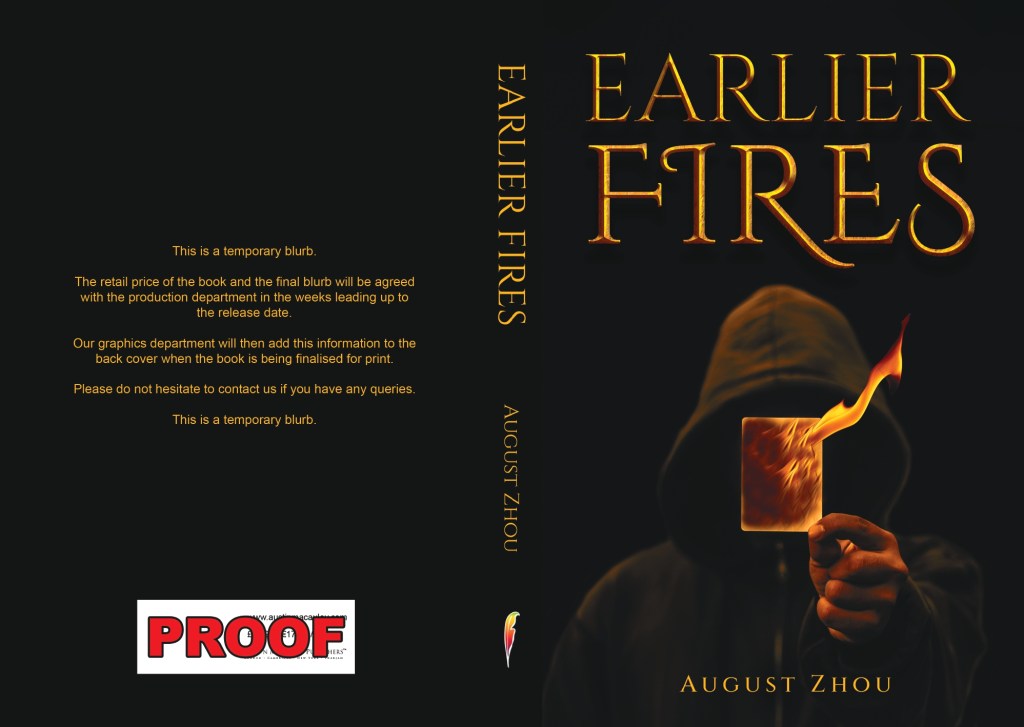
There is so much more going on in this novel—it wouldn’t be unfair to say too much—but all of it is meant to be held together by a central preoccupation; and I must say that the book cover Austin Macauley’s production team designed addresses this central preoccupation very aptly, more so than the narrative itself does. Earlier Fires is a novel about the alienating strangeness of trying to enact justice. Adrian spends much of the book trying to figure out what justice can even look like since nothing ever starts on a clean slate. Everything is already in motion. Historical actors, long dead, have shaped the world according to their visions driven by a hunger for power and control; what should subsequent generations do about this bloodstained legacy of inequities? Especially when they are on the winning side? The novel’s title alludes to Billy Joel’s “We Didn’t Start the Fire”, a song whose argument seems to be, since we’re not the first ones to commit moral atrocities, we’re in the clear to do whatever underhanded thing we want to gain an advantage. But who is? Who is ever the first one to commit a moral atrocity? Who started the first fire? There have always been earlier fires to point to. What I find apt about how the cover addresses the central theme breaks down into three parts. 1) The faceless cowled figure lurking in the shadows symbolizes how power operates behind closed doors. 2) The card that is on fire symbolizes how certain people are simply dealt worst cards in life. 3) The way the figure holds up the burning card to where his face should be demonstrates how inequality necessarily underwrites elite status: the accumulation of wealth and power has historically relied on lives whose fortunes must be burned away.
And why would such a novel be my first? Since my models for novelistic narratives were largely Western, with quite a number being American in provenance, I assumed my novel had to bear a family resemblance to those I’d read, or whatever theory I could stand to derive would be spread too thin, risking incoherence. I rather wish I’d read The Bonfire of the Vanities before I started writing.
I have, alas, no elegant theory to show for my efforts, just a growing tissue of half-formed thoughts on what the novel is and can do. There have been a number of pitfalls I’ve spent considerable time tumbling into while I wrote; and climbing out of while I edited and, thereafter, while I reflected upon the finished product. From all this disorienting and re-orienting experience, I hope to provide, if anything, key focal points the first-time writer of long-form narratives would do well not to overlook if what they want to end up with is something well put-together and respectably public-facing, rather than a labyrinthine hall of mirrors that is at the same time a private dungeon.
1) Setting. Not just in the sense of where and when, but situated-ness. What historical, social, and cultural contexts are your characters situated in? How qualified, to go off of lived experience and targeted research, are you to write about those contexts? The thickness of situated-ness cannot be falsified. It is better to narrow the setting down to achieve density in truthfulness. Writing head-on about an Important place or an Important time period or an Important set of people may make your reader feel like you’re too comfortable with generalizations, that you have nothing vital, nothing particularly important, to say.
2) Audience. Pandering is a strange and uncomfortable thing to do as a writer, but its opposite, the high-spirited disregard of how your intended audience might get a handle on your book, is an equally grievous mistake. As I say in my post on comma placement: Clear Communication conditions Precise Expression. You may think you’re reaching the inner sanctums of authenticity by enshrining a hypothetical someone like yourself as the ideal reader of your book, but what you’re really doing by writing like this is building a tumulus, a prominent burial site for the public to see. Such language makes prominent its own tightly sealed-off obscurity.
Wittgenstein makes this critical point in his iconic monograph Philosophical Investigations (1953): language is, at its heart, social; it is a game involving two or more parties, and the meanings and sense of language can only arise out of the interfacing required to accomplish cooperative tasks. Language is not, in the first instance, representational. It represents because that is a necessary feature of (practical) communication. The risk of forgetting your audience as you write is that your long-form narrative might fall into a para-social linguistic paradigm. Wittgenstein believed that a truly private language involving one person is impossible. I would agree, but a semi-private language is certainly very possible, that is to say, a language whose possibilities of communication have denatured into the strange joys of navel-gazing.
At any rate, authenticity isn’t predicated on the utmost atomization of the individual. Accounting your words to your intended audience, while you write, allows you to grasp more firmly the contexts your narrative addresses. You’ll think to spell out what might, on the final analysis, be obvious only to you and leave out that which is too idiosyncratic. This, too, is authenticity: to understand your own literary production as being part of a bigger picture of surrounding communities and circumstances.
3) Editing for Economy. Diction is important, but just as important is not overcrowding your well-chosen words. Everything—words, sentences, paragraphs—should be well-placed. Prolixity drowns out the mot juste. Too many inflection points would see your plot moving in a circle. There is an easy-to-miss milepost past which the length of your narrative lessens its impact. Weigh everything you set down on the page. Proportionality is the gestalt effect you should bear in mind when you think about what you should cut. Of course, it can be very difficult to abolish what already lives on the page. But even though a passage may be beautifully written, that in itself is no guarantee that it belongs in the particular narrative you’re working on. The pacing and direction of your narrative matter. A beautiful tangential passage is still just a tangent. Cast it out; find it a new home if you must, but cast it out from its current seat.
4) Characterization. Everyone is so introspective nowadays, it is easy to equate characterization with the contents of introspection. But a manifest of all that can be found in a character’s inner world isn’t the only way to achieve characterization. That is quite the painstaking way, and it can significantly slow down the pace of your narrative. Characterization has to come about from surer and swifter strokes, or the entire narrative risks becoming an extremely fastidious character study. Not exactly many people’s idea of a good read, though there is artistic value in it. Characterization isn’t, after all, quite the same thing as defining someone’s personality. A narrative is dynamic, and the people in a narrative have to move along with it. How they move along with it, how they tellingly react to situations, how they navigate the new roles that find them, is characterization. In life off the page, characterization comes along after the fact. Something has happened, and the person who’s experienced it looks backs, narratavizes, and thinks: so that’s the kind of person I am; now I know based on how I reacted.
5) Go easy on the Big Questions of Life. What is the meaning of Life? What is the point of Life? What is true success? What is true happiness? What is true fulfilment? What is true love? What is true freedom? Does money buy you happiness? How much wood, indeed, does the woodchuck chuck? And why? Who does that woodchuck even think he is? Does he have an unexpired permit to chuck all this wood? All these profound questions and more most pleasurably boggle our minds. We contemplate them as the people of antiquity contemplated the stars and the planets. These questions form a night sky of inviolably enduring mysteries. They are the assuring guide posts of our received wisdom. If we feel existentially lost, it helps to know that others are lost along the same lines. We may not be able to hear the eternal music of the spheres to harmonize our existence with the upper heaven of the Forms, but at least we’re all on the same wavelength, trying to do so.
What explains the fatal attraction writers have towards carrying the weight of a Big Question on their rounded shoulders? The truth is, the first-time writer may feel insecure about the importance of what they have to relate. Borrowing authority from a Big Question that goes straight to the heart of Life itself seems like a surefire way to gain some leverage for your narrative when it goes up against the indomitable insouciance of a faceless, nameless readership. The two questions hanging on the lips of this fidgety collective are curt and cutting: So what? What else have you got?
Yet Big Questions should only ever be placeholders for more localized questions. Afterall, no one lives Life; they live their own life in all the stark splendor and layered complications of those particular circumstances. The story you’re trying to tell is worth its telling. It is dense with shapely particularities. It has only to lose sight of the Big Questions for it to draw the manifold free-spirited connections it craves to draw.
Sei Shonagon, a court lady of Heian Japan, knew to populate her pillow book with such observations as to make a person realize the glaring incompleteness of Big Questions.
[47] Horses – In horses, very black ones with just a little white somewhere are special. Also those with chestnut markings, speckled greys, strawberry roans with very white manes and tails – the expression ‘wand paper-white’ is indeed an appropriate one here. Black horses with four white feet are also charming.
[48] Oxen – An ox should have a tiny splash of white on its forehead, and the underbelly, legs and tail should all be white.
[49] Cats – Cats should be completely black except for the belly, which should be very white.
Shonagon, Sei. The Pillow Book (Penguin Classics) (p. 52). Penguin Books Ltd. Kindle Edition.
Her unapologetic specifications for what she finds beautiful in the three animals she bothers to notice need no occasion or explanation. These observations are small but self-sufficient absolutes; they do not require the charter of universal truth and would not be improved by one. The specialness of an ox with a tiny splash of white on its forehead would go unnoticed if Lady Shonagon did not point it out. Let that be a reason for you to write your narrative in a way true to your own life in all its glorious resistance to being surmised.
 Musings of an Educator, Writer, & Lifelong Learner
Leave a comment