
Nota Bene: This post is littered with spoilers. Do NOT proceed if you wish to preserve the discussed text as terra incognita.
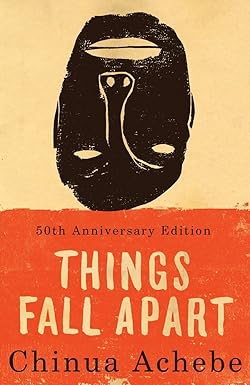
Things Fall Apart, first published in 1958, is the postcolonial novel that launched Nigerian writer Chinua Achebe into literary stardom. It is also a classic in the post-colonial canon though the choice to write this story in English, a colonial language, instead of a native language has drawn criticism from other African writers. Ngũgĩ wa Thiong’o is a Kenyan novelist, essayist, and academic, who began his career in English but has reverted to his mother tongue of Gikuyu, and these questions he poses embody the critical sentiment.
Why, we may ask, should an African writer, or any writer, become so obsessed by taking from his mother-tongue to enrich other tongues? Why should he see it as his particular mission? We never asked ourselves: how can we enrich our languages? How can we ‘prey’ on the rich humanist and democratic heritage in the struggles of other peoples in other times and other places to enrich our own? Why not have Balzac, Tolstoy, Sholokov, Brecht, Lu Hsun, Pablo Neruda, H. C. Anderson, Kim Chi Ha, Marx, Lenin, Albert Einstein, Galileo, Aeschylus, Aristotle and Plato in African languages? And why not create literary monuments in our own languages? Why in other words should Okara not sweat it out to create in Ijaw, which he acknowledges to have depths of philosophy and a wide range of ideas and experiences? What was our responsibility to the struggles of African peoples?
wa Thiong’o, Ngugi (p. 8)
As wa Thiong’o incisively observes, writing in the colonizer’s language is something of a pre-ordained defeat for the native writer trying to humanize their own culture and community—no matter how much of the writer’s mother tongue gets injected into the master language to add local color. In this view, the relationship of domination and superiority that obtains between colonizer culture and the colonized is conceded by the post-colonial writer’s choice of language, no matter what it is that actually gets written down.
As suggested by the title, the plot of Things Fall Apart tells the story of European colonialism, with the very public face of Christianity, disrupting settled ways of life in Igbo communities in the “lower Niger” (p. 208), leading to conversions, a restructured civil society, and, ultimately, subjugation to the ethos of Western civilization.
Yet, I don’t think Okonkwo, the protagonist of our novel, is the only moral center, and it would be this singular moral centrality which supports the straightforward interpretation of European colonial interference causing things to fall apart in Okonkwo’s village. His first son Nwoye is a moral center, too.
Where Okonkwo is strong, Nwoye is weak, in the father’s eyes. While Okonkwo embodies Igbo traditions and reveres native deities, his son makes the conversion to Christianity. Okonkwo is a strong patriarch figure, a chief, in the village of Umuofia; his strength stems from his athleticism as a wrestler, his prowess as a warrior, and the trust he places in tradition and ancestral spirits. His own father Unoka was weak, idle, and a lover of sensual pleasures, neglecting work, especially the farming of yams, the paramount masculine economic activity in the village, yam being “the king of crops…a man’s crop” (p. 22). Okonkwo, growing up, hated everything about his father’s ways and resolved, in defiance, to make something of himself. His fear is that Nwoye is more like his grandfather than himself.
In Okonkwo’s worldview, being a strong man is the backbone of the traditional Igbo economy.
During the planting season Okonkwo worked daily on his farms from cock-crow until the chickens went to roost. He was a very strong man and rarely felt fatigue. But his wives and young children were not as strong, and so they suffered. But they dared not complain openly. Okonkwo’s first son, Nwoye, was then twelve years old but was already causing his father great anxiety for his incipient laziness. At any rate, that was how it looked to his father, and he sought to correct him by constant nagging and beating. And so Nwoye was developing into a sad-faced youth.
pp. 13-14
The father cannot accept that his 12-year old son might not have the physical endurance that he has; it has to be a matter of choice, instead. It has to be laziness or Igbo society is undermined.
Is such “laziness” weakness? It is also difficult for the reader to see other key aspects of Nwoye’s weakness as anything other than…something like basic compassion? Achebe makes the point that this compassion is basic, rather than a product of European/Christian acculturation, by having Nwoye react in ways telling of such compassion, before he is exposed to Christianity.
Consider the spiritual taboo of twin births in Umuofia. Twins have to be put into earthen pots and thrown away into the forest and left to die, as so decreed by the Earth goddess, because they are an “offense on the land” (pp. 61, 125). Nwoye finds this practice horrifying; he is someone who is too squeamish to keep up the custom. But even Okonkwo, who has practiced this custom many times with one of his wives, finds himself wondering about the discarded twins: “What crime had they committed?” (p. 125).
The execution of Ikemefuna by Okonwo, an execution of foster son by foster father, speaks more chillingly to the possibility that Nwoye’s aversion to native beliefs comes from a place of simple fellow feeling.
Ikemefuna comes from the neighboring village of Mbaino. One night, a woman of Umuofia went over to the market at Mbaino and was killed. Two options follow: 1) a retaliatory “just war” or 2) “the offer of a young man and a virgin as compensation”. The second option is chosen; the virgin replaces the dead woman as wife. Ikemefuna is the young man offered, and for three years he is put under Okonkwo’s charge (pp. 11-12). Okonkwo, though never showing his favor, would become “very fond of the boy” (p. 28). Nwoye treats Ikemefuna like a brother. Ikemefuna is fully incorporated; not before long, the outsider “had begun to feel like a member of Okonkwo’s family” (p. 34).
But Ikemefuna still has to die. Ogbuefi, the oldest man of Umuofia, relays this message to Okonkwo:
Umuofia has decided to kill him. The Oracle of the Hills and the Caves has pronounced it. They will take him outside Umuofia as is the custom, and kill him there. But I want you to have nothing to do with it. He calls you his father.
p. 57
Thus, native ancestral piety supersedes familial feelings and human affection. The spirit of the village Umuofia demands Ikemefuna, a representative of the offending village, as sacrifice, and the villagers of Umuofia have to abide. Heartbreakingly, when the first blow is struck, Ikemefuna yells out, “‘My father, they have killed me,’” and Okonkwo reacts by dealing the final stroke of the machete: “He was afraid of being thought weak” (p. 61).
The killing of Ikemefuna, his adoptive brother, deeply scars Nwoye, the supposed weak son of Okonkwo: “something seems to give way inside him, like the snapping of a tightened bow”. In fact, the only other time he felt this feeling of something giving way inside him was when he, “not long ago”, heard “the voice of an infant crying in the thick forest” and realized that this voice belonged to an abandoned twin in the forest (pp. 61-62).
When Nwoye is exposed to Christianity, it is not the doctrine which convinces him; it is precisely because the religion seems to address the strange snapping feeling he experienced when he heard the cry of an abandoned twin and when he realized Ikemefuna had been killed.
It was not the mad logic of the Trinity that captivated him. He did not understand it. It was the poetry of the new religion, something felt in the marrow. The hymn about brothers who sat in darkness and in fear seemed to answer a vague and persistent question that haunted his young soul—the question of the twins crying in the bush and the question of Ikemefuna who was killed. He felt a relief within as the hymn poured into his parched soul. The words of the hymn were like the drops of frozen rain melting on the dry palate of the panting earth [my italics].
p. 147
In other words, even if the religion of Christianity is confusing, it ratifies the basic compassion Nwoye feels towards the disposed twins and the slain Ikemefuna; he is finally given affirmation that such acts are cruel and senseless, something he has always felt in his marrow.
This basic compassion radically reshapes traditional Igbo society. When Christianity gains a deeper foothold in the village of Mbanta, the parish and converts live in the “Evil Forest”, so called because that’s where twins are left to die, but now they are rescued by Christians and raised as one of their own (p. 154). Outcasts, too, descended from slave peoples, are given a second lease on life by the Christian community, though with initial resistance from some converts (pp. 155-156). Igbo society does not fall apart solely because of the external pressure of Christian morality. There are already cracks from within, such as with Nwoye and other members who find native ways unjustifiably cruel, as well as the outcasts living in the margins of society, castigated as subhuman for being born into slavery.
Yet it mustn’t be thought that the Christian missionaries had a firm understanding of what we might call basic compassion. Mr. Kiaga, the interpreter for the white pastor who brings Christianity to the Igbo, and soon the head of his own congregation, succeeds in convincing Nwoye to convert to the new faith, and his reaction upon hearing the news of conversion is unequivocal in its judgment.
Mr. Kiaga’s joy was very great. “Blessed is he who forsakes his father and his mother for my sake,” he intoned. “Those that hear my words are my father and my mother.”
p. 152
Just as the Igbo people reject twins from their community, the Christians are as absolute in their attitude about spurning non-Christian members of family, even if it is one’s father or mother. Christian compassion seems to be founded on bright dividing lines. The white pastor Mr. Kiaga interpreted for did not mince words when he first arrived at the village of Mbanta: “’We have been sent by this great God to ask you to leave your wicked ways and false gods and turn to Him so that you may be saved when you die,’” (p. 154). The utter contempt the white pastor has for the Igbo worldview can hardly be anyone’s understanding of compassion.
And perhaps “basic compassion” is itself a deficient concept. There are forms of compassion, if we wish to retain the term, that require more complicated and laden ways of conceiving fellow feeling. When Okikia, a famed orator, speaks to the prominent male leaders of the nine Igbo villages, he bemoans a common loss, a loss beyond the loss of human lives, to rouse them to action against the encroaching colonial power.
“All our gods are weeping. Idemili is weeping, Ogwugwu is weeping, Agbala is weeping, and all the others. Our dead fathers are weeping because of the shameful sacrilege they are suffering and the abomination we have all seen with our eyes.” He stopped again to steady his trembling voice.
p. 203
What is the worth of the character of a people? Okikia forces us to consider. How should their time-honored lifeways be weighed against the crime of taking innocent lives? The Igbo villages have built a collective identity around warfare and an ancestral earth faith; this is what the Christians are trying ruthlessly to eradicate; they’re there not only to save innocent lives.
Ultimately, what falls apart throughout the novel is the Eden of moral insularity. Contact between the two vastly different moral traditions leads to the disfigurement of both. Through interfacing, both Christianity and the Igbo religion are shown in their worst light; both are exposed for the stark cruelties they endorse.
The brilliance of Achebe’s novel is that it reveals compassion to be much more fraught and treacherous than what we take it for. There is such a thing as basic compassion, but there is also so much of compassion that ventures beyond the simple basis of wanting to help someone who’s suffering. Compassion can easily go hand in hand with far darker and crueller values.
As I was reading this novel, I was torn between identifying Okonkwo’s perspective or his son Nwoye’s as the moral center of the novel. While Okonkwo’s perspective is a stand-in for the psychic injury the colonizing faith inflicts on the Igbo communities, Nwoye’s perspective tells of how Christian interference does much good by abolishing traditionally legitimized forms of violence, exclusion, and repression. It is only when I realized father and son’s perspectives are essentially irreconcilable, that I understood the fatalistic message of the novel for what it is. The two standard and polar-opposite stories about colonialism are both painfully reductive: 1) that of a civilizing mission to reform savage ways; and 2) that of a pestilential foreign culture contaminating elementally enlightened “kumbaya“ societies. If the truth can be made to stand in either story, things wouldn’t fall apart.
Whatever else compassion may be, Things Fall Apart shows that it is not a value religion teaches—but a basic human sentiment religion manages and controls for the advancement of its own ends. The novel, torn between two moral centers, perhaps doesn’t have one at all. In its place is a gyre of fragmenting value systems and disintegrating cultural traditions.
 Musings of an Educator, Writer, & Lifelong Learner
Leave a comment