Nota Bene: This post is littered with spoilers. Do NOT proceed if you wish to preserve the discussed text as terra incognita.
If you had to choose, would you rather a) lose all your friends and family or b) lose all access to literature, art, and music?
An absurd and unsettling question, you say? Because why would you have to make a choice, at all? The two are distinct but related spheres of existence that go together to create a fulfilling life.
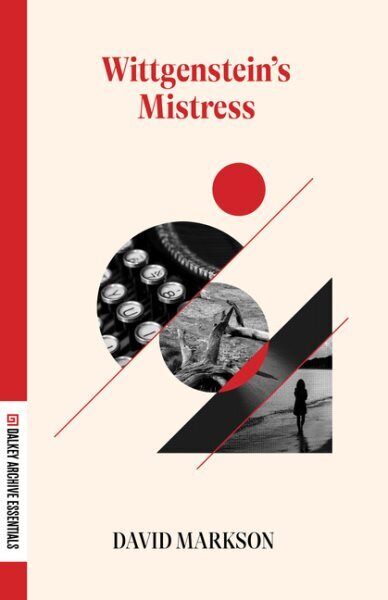
In Wittgenstein’s Mistress, first published in 1988, these two spheres are, however, not so distinct, and it is even less certain that either sphere has created a fulfilling life for the narrator, who presumably goes by the name “Kate”. We have to defer to presumption because the narrator has an outstandingly slippery memory. Not only are names jumbled up, but actions and behavior are often attributed, in contradiction, to various people. And by people, I mean flesh-and-blood persons, whether personal relations of Kate’s or historical figures in the world of high culture; but also literary characters.
The oeuvre of the author, David Markson, is rife with metafiction; many of his literary productions, like this one, experiment with the form of the novel to its breaking point. Consider these titles: This is Not a Novel (2001) and Last Novel (2004). This does not mean that Wittgenstein’s’ Mistress is without a plot. Much of the experimental novel just does not develop the plot, although the events of what readers of traditional novels would consider the plot, or the premise, are alluded to, throughout, by our unreliable narrator.
So, if they don’t develop the plot, what are most of the words in Wittgenstein’s Mistress doing? What do these words that Kate puts down at her typewriter, with regularity, detail?
Think of it like this: if your local pub did a Trivia Night, and the theme was High Culture, you would not be surprised to see Kate provide an answer to every single question. Much of the book is Kate, herself a painter, thinking back on all the fiction, non-fiction, and philosophy she’s read; all the paintings she’s seen; and all the music she’s heard; and she’s dwelling on the personal lives of the individuals who created these works.
But Kate wouldn’t win at Trivia Night; she might not even score a single point because of how frequently and egregiously she jumbles her facts up. To illustrate the extent of her misremembering, a few representative mix-ups are as follow:
- “Have I ever said that Turner once actually had himself lashed to the mast of a ship, to be able to later do a painting of a storm?” (p. 199). Kate mistakes the 18th century English Romantic painter William Turner for Odysseus, with particular reference to Odysseus’ encounter with the sirens, where he has himself tied to the mast of his ship, so he’s able to hear the sirens’ endless song of heroic acts around the world without suffering the consequence of being so enchanted as to starve to death from listening to their songs and doing else. Turner’s painting, Snow Storm: Steam-Boat off a Harbor’s Mouth, is the painting alluded to.
- “Then again, Rainer Maria Rilke once wrote a novel called The Recognitions, about a man who wears an alarm clock around his neck, which seems less like a lie than just a foolish subject for a book altogether.” (p. 206). Rainer Maria Rilke is a 19th and 20th century Austrian Modernist poet and novelist; William Gaddis, an American postmodern novelist, is the person who wrote The Recognitions. Kate’s description of the premise of the novel concerning an alarm clock is, in actuality, just the distinguishing trait of a minor character, Mr. Feddle, in The Recognitions.
- “And in which a part I always liked was when Clara Hepburn gave Ludwig Wittgenstein some sugar.” (p. 252). Kate is referring to a biography entitled “The Life of Brahms”. Clara Schumann is the patron of 19th century German Romantic composer Johannes Brahms and someone Brahms could have had an “affair” with (p. 130). “Hepburn” refers to Katharine Hepburn, an actress of Hollywood’s Golden Age (star of The Philadelphia Story, etc.), who plays Clara Schumann in the 1947 film Song of Love, a film Kate caught in Vienna when she was a girl (p. 130). Ludwig Wittgenstein, the Vienna-born analytic philosopher in the title of this novel, used to carry sugar in his pockets, going for walks around Cambridge, at whose university he pursued philosophy, in order to “give it to the horses he might see in the fields while he was walking” (p. 231).
Not only are there facts and mistaken facts about High Culture, idle speculations, too, abound.
- “On the other hand it is probably safe to assume that Rembrandt and Spinoza surely would have at least passed on the street, now and again.” (p. 148).
- “Willem de Kooning is descended from Rembrandt, one would have heard.” (p. 141).
- “Surely Clytemnestra would have wished to see her own sister after that same ten years in any event. But what I am only now also remembering is that here is Cassandra being an old friend of Helen’s on her own part” (p. 209).
And, at times, the likelihood in Kate’s speculations mutates into the counter-factuality of delusions involving herself and figures of high culture. (The sentence-length paragraphing presented below is the text’s original format, not my superimposition.)
What really happened, once, was that I wrote letters to a considerable number of famous people.
So that to tell the truth Martin Heidegger was not even the most famous person I wrote to.
Certainly Winston Churchill would have been considered more famous than Martin Heidegger.
In fact I am positive that Picasso would have also been considered more famous than Martin Heidegger[…]
[…]But be all that as it may I wrote letters to every single one of these people.
And as a matter of fact I wrote letters to more people than this.
Some of the other people I suspect I may also have written to were Bertrand Russell, and Dmitri Shostakovich, and Ralph Hodgson, and Anna Akhmatova, and Maurice Utrillo, and Irene Papas.
Moreover I suspect I may have even written to Gilbert Murray and to T. E. Shaw.
Although when I say I suspect in regard to these latter cases it is because with a good number of them I can no longer be certain.
The chief reason I can no longer be certain being simply that I wrote all of these letters a good many years ago.
But too, another reason is that a certain number of the people I have mentioned may in fact have already been dead by the time I wrote the letters.
pp. 218-219
It is the same message in all these letters: she needs help naming her cat and she would like their suggestions (p. 220). Unfortunately, for these venerable dead, the cat Kate owns isn’t even real, “there being no cat except insofar as the sound of the scratching [of tape hanging on to a broken window in the next room] reminds me of one.” (p. 62).
Perhaps, we shouldn’t be too puzzled by the narrator’s idiosyncratic, off-kilter way of deriving meaning from high culture. After all—and this is the big lynchpin revelation of the novel—she woke up one day to discover that she is inexplicably the only human being left on earth; not just the last human, but no other animal is left; no cat, for one thing. Solace, not meaning, is what she seeks from high culture. Her obsession is a helpless one for pseudo-companionship.
Would this premise, Kate’s unhappy situation, be allegorical commentary on the loneliness of consuming high culture? On Alienation and Solipsism? On the blurred boundaries between human and literary relationships for someone who is too fixated on high culture? Yes, all yeses. And let’s not forget that the title alludes to Wittgenstein, since what we’re doing now is racking up points for the novel’s avant-garde-ism.
The reason why so much of the novel is narrated through factual statemetns about high culture and about Kate’s own life is the Tractatus Logico-Philosophicus (1921), Wittgenstein’s thesis in Philosophy at the University of Cambridge. The Tractatus is a work that aims to explain the metaphysical make-up of the world in logical propositions: facts rather than things, as things are conventionally understood to mean, are taken to be the fundamental building blocks of the world. The famous first statement of the Tractatus reads: “The world is everything that is the case.” (p. 25).
The reason why so many of Kate’s recounted facts are mistaken and seem to make unstable references to people or incidents is Wittgenstein’s second and last published philosophical endeavor, Philosophical Investigations (1952). This second work of Wittgenstein’s refutes the founding axiom established in the first by casting doubt on the ability of language to have access to ultimate truths, an ability taken for granted in the Tractatus and in the intellectual tradition of Western philosophy up till Wittgenstein’s second philosophical work. If language is unable to refer to things in ultimately stable and true ways, the philosopher can’t formulate logical propositions about the world which can represent the way the world truly is, past all change and appearances. The presence of Philosophical Investigations in Wittgenstein’s oeuvre is what causes the narrator in Wittgenstein’s Mistress to constantly the doubt the veracity of what she recalls. As Kate herself sums it up:
In addition to remembering things that one does not know how one remembers, one would also appear to remember things that one has no idea how one knew to begin with.
p. 62
If this world of unstable reference is the one Kate lives in, plus the fact that there is no actual human being or even cat left, can we, her readers, fault her at all for being hyper-fixated on the biographical tidbits of literary characters and figures of high culture, like as if she knew them personally? Her unorthodox form of appreciating high culture is just a balm for an exceptional situation of loneliness, is that not it?
If there’s no human or non-human animal left, wouldn’t you, too, derive companionship, the way Kate does, from historical figures and fictional characters of high culture? They feel familiar because they’ve been around for a long time—and there is a kind of virtual community founded on your knowledge that a number of other people throughout the ages have also looked at this, here, painting, or heard this composition, or read this novel.
But what if this solipsism of Kate’s began before the total and sudden disappearance of all other persons, human or non? What if, for Kate, this radically lonely world of hers is not the worst outcome? That there might be a greater loneliness for someone like her, hard to imagine as that is? Pondering this possibility in the frame of autofiction, Kate asks:
Would it have made any sense whatsoever if I had said that the woman in my novel would have one day actually gotten more accustomed to a world without any people in it than she ever could have gotten to a world without such a thing as The Descent from the Cross, by Rogier van der Weyden, by the way?
Or without the Iliad? Or Antonio Vivaldi?
I was just asking, really.
p. 245
Is she just asking? Is this an idle speculation without any personal bearing on our narrator Kate? Might she not, in all honesty, choose art, literature, and music over actual people?
For all that this novel is metafictional and avant-garde, there are traditional elements of plot to be discerned in it. These elements hint at a darker picture of what high culture means to Kate.
Kate had a husband and a son; even their names and the things they did she mixes up in the course of her narration. There is, in fact, an unsettling sense of equivalence between the characters and figures of high culture on the one hand and Kate’s husband and son on the other. In her worldview, all that she ambiguously associates with people, books, music, and art is “baggage”, a term which occurs repeatedly in Kate’s narration. On the Total Sudden Disappearance, she remarks:
Nonetheless, what would appear to remain the case on my own part is that one day I had baggage and then one day I did not. Although very likely it was hardly that simple either.
Accoutrements, I did get rid of. Things.
p. 90
So it is for Kate that “baggage” refers to something more figurative than physical. Physical things can be associated with the baggage Kate perceives her psyche to be carrying, but they are, in and of themselves, simply things, accoutrements. And physical stuff is certainly easier to get rid of than psychic baggage.
Kate has quite a large deal of psychic baggage. Throughout her narration, she refers herself as dealing with madness, a madness that doesn’t always affect her; there are “periods when I was mad and periods when I was not, when one comes down to it.” (p. 82). This madness, Kate suggests, serves a strategic function; Michelangelo, to go by Kate, makes the claim that “there is no better way than being sane and free from anxiety than being mad” (p. 202); though later on in her narration, it is another Italian Renaissance painter who makes this claim, “Leonardo” (p. 245). Regardless of accuracy in attribution, Kate feels strongly about this conception of protective madness.
The obvious connection between dots to draw is that the Total Sudden Disappearance traumatized her and caused her to develop a form of madness to help her cope. Yet, as she says, it’s “hardly that simple”; she had baggage even before the Total Sudden Disappearance.
You see, Kate believes herself responsible for her son’s death, this unfortunate death being yet another constant motif in her narration. She reflects:
There being surely as many things one would prefer never to remember as there are those one would wish to, of course.
Such as how drunk Adam had gotten on that weekend, for instance, and so did not even think to call for a doctor until far too late.
Well, or why one was not there at the house one’s self, those same few days.
Being young one sometimes does terrible things.
Even if life does go on, of course[…]
[…]And even if it was nobody’s fault that Lucien died after all.
Although probably I did leave out this part before, about having taken lovers when I was still Adam’s wife.
Even if one forgets whether one’s husband had become drunk because one had done that, or if one had done that because one’s husband had become drunk.
Doubtless it may have been a good deal of both, on the other hand.
Most things generally being, a good deal of both.
And none of what I have just written having been what really happened in either event.
Since both of us were there, that weekend.
And could do nothing about anything, was all.
pp. 237-238
There are two accounts of events implied here, regarding how her son died in a mishap. The first account places heavy blame on her and her husband’s negligence. The second one exonerates them. 1) The death of her son could have been prevented if she had not been out of the house engaging in an extra-marital affair or if her husband had been sober instead of being so drunk as to lack the wherewithal to call a doctor in time for their son’s mishap. Or: 2) The mishap was so severe that, once it happened, even though she and her husband were there in the house, there was nothing they could have done to save their son. Nonetheless, in this account, she likewise was engaging in extra-marital affairs and her husband had a drinking problem; the difference is, they were there to respond when the fatal incident happened.
The equal validity of the two possibilities makes sense once we piece together what mishap befell their son. We get a subtle hint when she returns to Mexico by herself, where she, her husband, and her son were living, to visit her son’s grave.
When I was back in Mexico, all through that winter I could not rid myself of the old habit of turning my shoes upside down each morning, so that any scorpions inside might fall out.
pp. 22
A fatal scorpion sting when her son was putting on his shoes. It being winter, the temperature too cold for bugs to be out and about, there is no reason for Kate to check for scorpions—but she does it compulsively because she remembers all too well the tragic thing which happened a long time ago because she and her husband neglected to do so. Whether a doctor could have arrived in time to save their son is anybody’s guess.
The guilt is so strong that Kate douses her son’s old room in gasoline to burn it, and the entire house, down, “[a]fter turning my shoes upside down, naturally, in case of scorpions, even though there could no longer have been any scorpions.” (p. 236). The guilty tic will not let her forget what her negligence wrought.
But how is any of this related to her strange obsession with high culture? We return to the question I started this post off with: if you had to choose, would it be high culture, or your friends and family?
Kate seems to have chosen high culture all along, to the neglect of her personal relationships, the most tragic result of this being her son’s untimely death.
Let’s not forget that Kate is a painter. And quite an ambitious one; the refrain which opens and ends the novel goes like this:
Once, I had a dream of fame.
Generally, even then, I was lonely.
pp. 29, 254
That dreaming about fame could possibly alleviate loneliness is not, to most people, an apparent causal relationship. But for Kate, this dream of fame is an artist’s feverish dream. It is a dream of entry into the halls of high culture, the dream of artistic immortality. It is a lonely journey, no doubt, creating art and dreaming of enduring fame, but the thought of being remembered and hopefully admired does something to alleviate the artist’s loneliness.
But art requires sacrifice, personal sacrifice. In all of Kate’s years as an artist and mother, she never got around to painting a portrait of her son.
Then again having never painted any sort of portrait of poor Lucien at all, on the other hand.
Though there is the framed snapshot of him in the drawer beside my own bed upstairs, of course.
p. 237
A son whose name she does not always get right.
There were times when I regretted that I had never done a portrait of Simon, however.
p. 68
In general, Kate confesses, “[…]I rarely did portraits” (p. 68). People are not her forte.
Kate has done a portrait of her own mother, when her mother was “exactly fifty” (p. 68) but there is a vested artistic interest in this. Kate really does not reveal anything at all about her parents, except that they, after her son died, died “next” (p. 238); in fact, pretty much the only thing she is able to recall her mother having said to her pertains to her vocation of being a painter.
There was a tiny, pocket sort of mirror on that same table beside my mother’s bed, those final weeks.
You will never know how much it has meant to me that you are an artist, Kate, she said, one evening.
p. 32
Did Kate think to paint a portrait of her mother (and doing one for her father, by the by, since the occasion is their wedding anniversary) primarily because of the interest the mother shows in the daughter’s artistic endeavors? Is Kate able to relate much to people, outside of shared artistic concerns?
Recall that Kate admits she would likely be better suited to a world without people than a world without high culture.
As it were, we should spell out why she no longer dreams of fame—because there is no one left, no one left now or down the pike to look at her paintings and remember her as an artist; though she takes the liberty to play out her fantasy of artistic fame by leaving portraits of her mother and father “at the Metropolitan Museum, in one of the main painting galleries on the second floor.” (p. 33).
Kate never got to the point of achieving artistic fame and kept up the chase. Now that everyone’s gone, she feels alienated and lonely—but maybe not in the straightforward way we assume someone in her situation would feel. Her present loneliness might well stem from her forever defeated dream of artistic fame, not so much the absence of other people.
And Herodotus was almost always spoken about as having been the first person ever to write down any real history, incidentally.
Even if I am not especially overjoyed at being the last.
As a matter of fact I am quite sorry I said that.
Such thoughts again being exactly the sort one would have wished to believe one had gotten rid of with the rest of one’s baggage, naturally.
p. 199
Being the last to write history would naturally mean that fame in the hallowed halls of high culture is not a possibility. The impossibility of such fame is traumatic to Kate; this is the psychic baggage she has to carry around. She is not particularly looking for other people. After the Total Sudden Disappearance happened, Kate had a phase of leaving messages out in public, in hopes of finding another human soul; but, really, not that many messages, at all.
IN THE BEGINNING, sometimes I left messages in the street.
Somebody is living in the Louvre, certain of the messages would say. Or in the National Gallery. Naturally they could only say that when I was in Paris or in London.
Somebody is living in the Metropolitan Museum, being what they would say when I was still in New York.
Nobody came, of course.
Eventually I stopped leaving the messages.
To tell the truth, perhaps I left only three or four messages altogether.
p. 4
I believe we should take her word for it that she did not leave more than four messages. For one thing, her messages speak of her situation of living in a museum, and who would go out n their way to do something like that except, say, a painter who has always dreamed of eternal artistic fame, someone who would choose, if it came to it, the company of paintings over that of people?
Kate’s priority of sympathies is most clearly apparent when she begins on a list of poor-so-and-so for-such-and-such-reasons. Beginning with Guy de Maupassant, she moves on to Nietzsche, then Vivaldi, Bach’s widow Anna Magdalena, Bach and Anna’s children, Robert Schumann, Franz Schubert’s ghost, Tchaikovsky, James Joyce, Beethoven, Sappho, John Ruskin, A.E. Housman, Keats, Aristotle; and the list goes on before she starts in on the mythological characters of the Iliad, namely Hector, Patroclus, Iphigenia, and Astyanax, and in this mix, the spiders Spinoza used to go looking for to make them fight receive a mention, too. Finally, she gets to her aunt Esther before she moves right on to depictions in a painting: “poor all the youngsters throwing snowballs in Bruegel, who grew up, and did whatever they did, but never threw snowballs again.” And, as an afterthought, she acknowledges that everyone who has disappeared overnight deserves some measure of sympathy: “for that matter poor practically the whole world then, more often than not.” (pp. 245, 247-249).
Wittgenstein’s Mistress was a difficult read for me not only because of the density of the allusions, many obscure; nor only because so much of Kate’s narration seems to have nothing to do with a plot, and reading that felt like swallowing dry muesli, until I got to the big reveal and everything fell into place and the narrative made sense at last. What made it a difficult read for me, on top of all this, is that Kate’s particular attitude towards high culture throws my own into sharp relief and casts an unflattering light on it.
I really do not wish to think that I appreciate high culture in the ways that Kate does. Let me first object to the use of the term high culture in my own particular case. I do not think along class lines when I pick out books like Wittgenstein’s Mistress or the Iliad to read. It is not about appearing or becoming “cultured”. Highbrow or middlebrow or lowbrow culture only tells you which demographic is likely to consume such works. Such labels, alone, don’t offer a reason to afford any particular work appreciative attention.
I will freely admit—as a show of good faith that I’m not trying to appear as someone with prestigious tastes—that I don’t connect much with art music, like the compositions of Brahms, or what have you. Paintings, too, I have not spent that much time admiring and trying to understanding. Impressionism, especially Monet’s Water Lilies series, yes. Liliana Porter’s beautiful and thought-provoking red sand installation stays with me. 17th-century Dutch genre and landscape paintings are a treat. And, generally, I will always make it a point to check out a couple of museums when I get to a new city. Literature, I do spend a lot of my personal time on, whether reading or writing. But the bottom-line is this: I don’t spend the bulk of my spare time thinking about the personal lives of famous painters, writers, and composers, like Kate does. That strikes me more as celebrity worship rather than artistic appreciation. It is bizarre. Kate herself wonders if she actually read The Life of Brahms at all; all the information she has retained about Brahms might have just been gotten from “reading the backs of the jackets on phonograph records.” (p. 176). This is not scrupulous engagement with a cultural artifact. It is an obsession with peripheral details, a strange wish to obtain culture by association.
The term I would propose in place of high culture to explain why I care about works such as the Iliad would be something along the lines of ambitiously authentic cultural artifacts. Some works are more ambitious than others; that is a plain fact. An experimental one like Wittgenstein’s Mistress is such an example. And they’re often ambitious in the sense that the artist wishes to say something originally truthful, and do so by making the most of the advantages their unique abilities and circumstances grant them. Such a work is an authentic coming together of personal inspiration and skills in a historical moment. It is a tough undertaking, and it often doesn’t pan out because the public has no appetite for it. But when it does, such works survive. They endure the test of time because we see continued relevance in them, as it is with the Iliad. Not perhaps the same relevance for Golden Age Athenians as for us, but we are in the same country when we hear Homer sing.
The virtual community provided by such enduring works can be highly seductive. Reading up all about it, in the manner of celebrity worship, can become a fatal consolation, as it has for Kate; the artist can become too obsessed with seeking admittance into the halls of eternal fame after repeated denials. This obsession can lead you, as an artist, to neglect the ethical commitments you bear towards the very real people in your life, in order to better your chances of rubbing shoulders with Homer, Sappho, or Breughel, one undying day.
Wittgenstein’s Mistress, as much as it is an experimental novel, also functions as the traditional narrative form of the cautionary tale. The warning is this: Do not, in your lust for fame as a creative type, mistake figures long dead and gone, as your flesh-and-blood community. They are spirits of different ages, and such spirits can provide much succor and even critical strokes of inspiration in times of distress, melancholy, or heightened anxiety—but people you bear ethical commitments to, these spirits, decidedly, are not.
Think again upon Kate’s image of William Turner tying himself to a mast in the midst of a storm just so he could paint it with fidelity. Making personal sacrifices for your art may be necessary, but it may just as well be treacherous. The artist might, Odysseus-like, hear a siren song in the lashings of water and the rumble of thunder; they might never untether themselves from the mast in their pursuit of artistic immortality, even though everyone else is down there on the deck, some of them waiting for the artist’s return.
Works Cited
Markson, David. Wittgenstein’s Mistress. Dallas: Dalkey Archives Essentials, 2023.
Wittgenstein, Ludwig. “The Project Gutenberg eBook #5740: Tractatus Logico-Philosophicus.” 24 March 2024. https://www.gutenberg.org/. <https://www.gutenberg.org/files/5740/5740-pdf.pdf>.
 Musings of an Educator, Writer, & Lifelong Learner
Leave a comment