
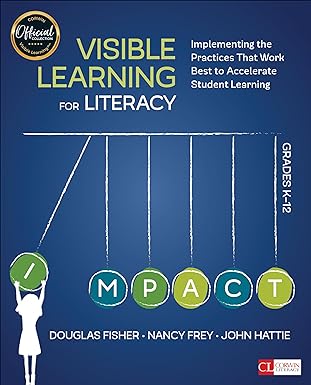
This post is a personal reflection on the stated text. It is, by no means, a comprehensive discussion of the contents of the book but, rather, a summary of insights and practical suggestions that I found useful for my own teaching practice.
Layout & Overview
The book begins by discussing how literacy practices have differential impact on student learning. Teachers should prioritize literacy practices that have effect sizes on learning bigger than what students would get from simply being enrolled for an academic year. The authors run a meta-analysis of different studies and highlight three outsized factors: 1) teacher credibility, 2) teacher-student relationships, and 3) teacher expectations. These factors contribute to “visible learning”, learning that is plain to see, set off from the learning students would acquire from simply being in school.
The book then moves on to discussing three different levels of literacy: 1) surface literacy, 2) deep literacy, and 3) transfer.
Takeaway 1
Surface literacy, or surface learning, is a critical step. It is the foundation. Teachers like to emphasize that their students are learning deeply. This presumes that their students already have a grasp of the basic facts, conventions, and controlling ideas within a discipline. This is a big presumption to make. Teachers should devote a large part of their instruction to helping students memorize and consolidate all the different basic items of content, such as vocabulary, before moving on to deep-learning tasks.
Takeaway 2
Deep literacy, or deep learning, is not just additive but subtractive. At this stage, students are encouraged to be autonomous learners: form their own connections between concepts, conduct their own inquiries, teach their peers and be taught by their peers, etc. All these classroom practices allow students to reach deep acquisition and deep consolidation of their knowledge. And part of this stage of literacy is that students know to question their previously held positions and assumptions about the subject. They learn to resolve contradictions in their knowledge. They learn to be welcoming of new ideas but also stringent with what they allow into their schematization of the given subject. I think of it as students developing their own “touchstones” for what counts as valid or useful knowledge in the content area.
Takeaway 3
The Transfer stage of literacy requires students to identify similarities and differences between two situations so they can transfer what they’ve learnt appropriately. This is the stage of context sensitivity. To show that you’ve truly learnt something you should be able to apply what you’ve learnt in one context to another by making the appropriate adjustments. If a mechanic has learned to fix one car, it doesn’t mean they’ve found the panacea to all car problems, but it certainly means that they may transfer what they’ve learned to the next car they’re tasked to fix, if they correctly identify what the differences and similarities are between car 1 and 2.
I think the best illustration of transfer and its importance is thinking about how we learn new items of academic, technical, or literary vocabulary. We learn these words in accumulations. It takes a while before we’re able to use or understand these words in most of their possible contexts.
Transfer comes down to transforming knowledge. Some activities related to this stage of learning are Socratic seminars, structured writing, and problem-solving tasks.
 Musings of an Educator, Writer, & Lifelong Learner
Leave a comment