Nota Bene: This post is littered with spoilers. Do NOT proceed if you wish to preserve the discussed text as terra incognita.
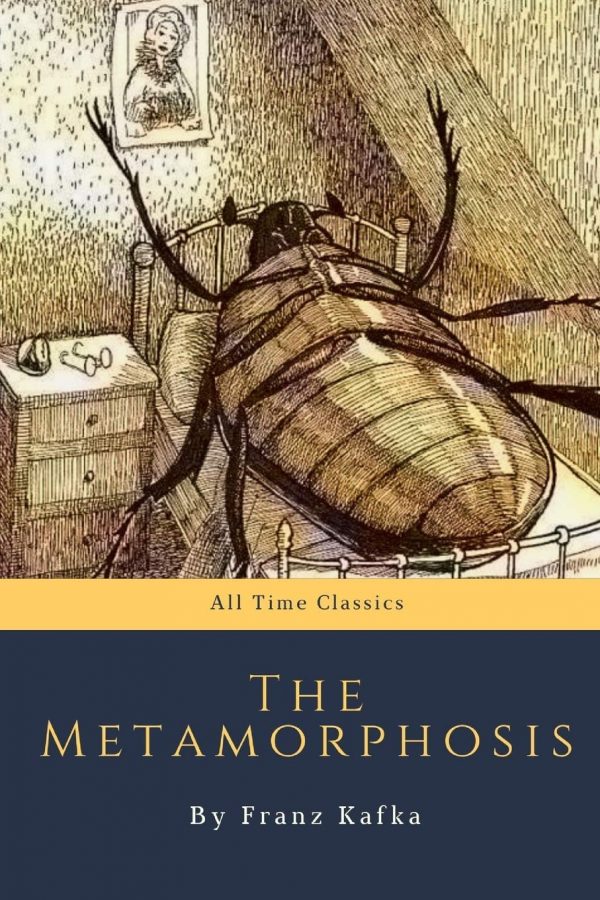
Is there any sinking feeling of dread more absurd than the “Sunday scaries”? Try waking up on Monday as a giant beetle. And the next thing you know, your supervisor is on the other side of your locked bedroom door, asking you to make an account of your absence, a one-off but an egregious misdemeanor nevertheless; your family is gathered there, too, trying to assuage your supervisor, vexed that you’re not doing your job, quite literally, but it is also your job to support them all on your own. Father has not worked for a while now, Mother stays at home, and your younger sister spends most of her time puttering around or taking violin lessons and practicing the instrument. Without your financial support, they are quite helpless. So hurry up and re-metamorphose to a travelling salesman for fabrics, as you were!
“The Metamorphosis”, published in 1915, is one of those stories that can be read in many ways: allegorically, psychoanalytically, symbolically, ethnically (Kafka being a German-speaking Jew in Prague invites this reading), or however you wish to plumb these dark, moldy depths. I have recently been to Prague, and I took the opportunity to visit the Franz Kafka museum; the city itself bears reminders of Kafka everywhere, including a giant, modularly rotating sculpture of his head, made of layers of stainless steel discs. At the museum, the strained relationship Kafka had with his father was made prominent to me; it had me thinking back on the novels and stories of Kafka’s I’ve read and how running into trouble with senseless authority always seemed to be a recurring theme. It is very, very tempting to take this recurring theme as flowing from Kafka’s personal issues with his hectoring, intimidating, business-savvy, go-getting, and highly critical know-it-all of a father. In this story, the father figure, compared to mother and sister, is certainly the harshest to our protagonist Gregor Samsa after he gets mysteriously bug-morphed.
In Kafka’s other stories, the legitimacy of counterposing authority figures is presented as entrenched; the protagonist may question the grounds on which he’s being treated harshly or callously by the authorities, but the question of why these institutions or people should even be vested with authority in the first place goes unexplored. That’s part of why the conundrum the protagonist finds himself mired in is so painfully absurd: authority is just there, already in place and indisputable.
In “The Metamorphosis”, a different picture of authority emerges: as a spiderweb (to add on to the bug theme) of distressing debt-like obligations, the exacting of which happens on pain of shame. In this spiderweb, people in society acquire debt-like obligations to one another simply based on the different roles they assume. These obligations are non-reciprocal; someone doesn’t have to give you anything for you to owe them something. As long as you have taken on a specific role, such as that of “son” or “breadwinner”, your debt to the pertinent people is secured. Authority, then, is to be found in the demands we get to make of people who are precisely those in the position to be of help or use to us in some way or the other.
The root of the story’s conflict might go unnoticed, since the premise of being turned into a bug is such an attention-grabbing one, but how the conflict is set off needs to be examined for us to understand what the premise drives at. What feeds the conflict in the story is a literal debt that Gregor’s parents owe the head personnel of the company Gregor works for, known mysteriously only as “Mr. Chief”. Gregor is thus working not just to support his family but to pay off his family’s debt. That’s why Gregor’s boss, “Mr. Manager”, presumes to come right up to the door of his bedroom to get him out of bed and to do his job: Gregor, quite unequivocally, owes him work. Gregor, in short, is trapped in debt bondage of the modern variety, yet how this debt came to be acquired is unexplained, this lack of an explanation being in keeping with the overall existential absurdity of the narrative.
What the story suggests, by introducing the notion of debt, isn’t just that working at a large company in modern times can be deeply alienating and dehumanizing. Debt operates in the story all throughout, both as a plot point conditioning the decisions Gregor’s family members have to make and as a metaphor for society-endorsed interpersonal obligations.
We’ll first look at how debt moves the plot. Because Gregor can no longer work, his father, mother, and even his teenaged sister have to find jobs to support themselves, making up for Gregor’s former economic functionality. It is gruelling, menial work, and they can’t match what Gregor made as a relatively successful travelling salesman. The Samsa family are forced to take on three lodgers, and still it is difficult to make ends meet. The worst part is, because of Gregor’s…condition, they can’t even move out of the apartment, which has become too big for their means.
Resentment builds. Gregor’s father is the worst of the three. From the start, he finds the bug-Gregor repulsive to an extreme and he does what he can to hurt him or shoo him away or confine him to his room. Gregor’s mother still sees the creature as her son, but her timidity makes it impossible for her to do anything beyond the bare minimum for him. It is Gregor’s sister who takes it upon herself to be Gregor’s caretaker, though she is repulsed by the sight of him, and he has to hide under a couch when she’s in his room to leave food and tidy up.
Eventually, things come to a head when the tenants realize what they’ve been living beside and demand restitution of their rent, knowing that the Samsa family are too ashamed of what they’re harboring and so wouldn’t want to be taken to court, where they’d be exposed to public scrutiny. The sister herself starts to resent the bug-Gregor, saying that the thing is no longer her brother, no longer a member of the family; that the real Gregor would never want to burden them like this.
Gregor takes the hint. He gradually dies from neglect and a prior injury caused by an apple, now decayed and causing an infection, his father threw so hard at him that it lodged in his back. The story ends on a happy note. The Samsa family move out to a smaller apartment. Though the three remaining family members are forced to take up industrious employment, and the debt to Mr. Chief is still to be paid off, they can’t help but feel a sense of possibility. Life is in the air again, and the parents notice that their daughter is coming into age nicely—attractively—ready to receive marriage proposals in short order.
As with the debt to Mr. Chief, Gregor’s metamorphosis itself goes unexplained. But if we look at how he upends the lives of his family from becoming unfit to work, we get the sense that the symbolism of being transformed into a repulsive bug speaks to the fact that Gregor has become economically unproductive. The spiteful disgust everyone feels towards him…is that not the same kind of disgust directed at people perceived to be useless? To be useless is to be a pest in society’s eyes, as the story makes it out. Mr. Chief is the figure of the head of society, no matter what type of society, modern or not. We still operate by primordial rules and precepts of work and usefulness. The chief of the tribe wants every member to contribute. If you can’t, you’re nothing; which is to say you’re nothing but a pest, a minus not a wash, a drain on resources, a burden. That’s the debt we individually owe to society at large: to contribute to the economy, to be useful in some way or the other. What Kafka brilliantly exposes is the seedy underbelly of a functional society in its organization of commonsensical judgments: there is an unyielding callousness society shows towards those do not contribute, even if it’s someone who, quite literally, cannot lift a finger to do any form of work.
Of course, there are private networks of support for those without employment: family in Gregor’s case. Yet the relationships in such a network can seem strangely debt-like, too. The resentment Father, Mother, and Sister feel towards Gregor stems from the fact that his loss of employment deeply inconveniences them. Never mind that, prior to his metamorphosis, he worked so hard and did so well as a traveling salesman that he was able to have his father quit his job, or that he paid for his sister’s violin lessons, and, generally, sustained the upkeep of the household while steadily trimming down the family’s debt to Mr. Chief. Or maybe it’s precisely that he was so useful and now he’s completely useless. They had grown accustomed to his providence; now they have to fill the chasm as best as they can. It is distressing, and somehow it feels like Gregor’s fault. Because Gregor can no longer make good on his debt to support his family, a debt he generously volunteered to take on, he has become an oversized burden to his family, a giant, revolting bug that takes up too much space in their household. With grim, absurdist irony, Kafka suggests that the way society works is, when someone has come to depend on you, you become indebted to them in that it falls upon you now to attend to their wants and needs; you owe them your beneficence as a bare minimum.
As the debtor in a dependency-debt, you are of course entitled to resentment, too. That’s exactly what Gregor’s sister goes through. She, on the strength of her close relationship with her brother when he still retained his human form, takes it upon herself to look after the bug-Gregor’s wellbeing. And she does manage to sustain her self-imposed duties for a while. In the end, however, the shameful stress of the situation gets to her, and she’s the one to raise the pitchfork and propose that they as a family cast Gregor out.
“It must be gotten rid of,” cried the sister. “That is the only way, father. You must try to get rid of the idea that this is Gregor. The fact that we have believed for so long, that is truly our real misfortune. But how can it be Gregor? If it were Gregor, he would have long ago realized that a communal life among human beings is not possible with such an animal and would have gone away voluntarily. Then we would not have a brother, but we could go on living and honour his memory. But this an- imal plagues us. It drives away the lodgers, will obviously take over the entire apartment, and leave us to spend the night in the alley. Just look, father,” she suddenly cried out, “he’s already starting up again.” With a fright which was totally incomprehensible to Gregor, the sister even left the mother, pushed herself away from her chair, as if she would sooner sacrifice her mother than remain in Gregor’s vicinity, and rushed behind her father who, excited merely by her behaviour, also stood up and half raised his arms in front of the sister as though to protect her.
(p. 44)
Lack of economic functionality is a death sentence. In this way, “The Metamorphosis” carries the same message as Melville’s “Bartleby, the Scrivener”.
To work is a requirement for gaining membership in humanity; this is the grim conclusion we come to, reading “The Metamorphosis”. A powerful scene in the narrative, where the bug-Gregor’s room is stripped of his furniture by his sister and mother, speaks incisively to how the lack of work dehumanizes a person. They balk at removing all of it since they know the human Gregor was very fond of his furniture, but they reason that as a bug he would need the extra space to creep around, and all that furniture would only be an impediment to his mobility. An unforgiving idea of merit underwrites this decision: Those who labor deserve to have the fruits of labor, such as furniture; those who don’t are just insects crawling around that have no need for what others produce with their hard work. Though the premise of the narrative is delightfully absurd, its message is a stridently realistic one.
Besides what I mentioned at the start about Kafka’s relationship to his father, another tempting connection between fiction and the author’s personal life begs to be made. Kafka worked as a legal clerk at the Workers’ Accident Insurance Institute. He must have processed a number of cases involving debilitating workplace injuries, injuries that would have effectively prevented the affected persons from acquiring gainful employment in the future, at least of the manual sort. I don’t know about the social safety nets the Kingdom of Bohemia had in place for persons who were no longer able-bodied, but if “The Metamorphosis” is anything to go by, being rendered unfit for employment must have led to a deeply alienating process of re-habilitation.
Works Cited
Kafka, Franz. The Metamorphosis. Translated by Ian Hackings, Feedbooks, 1912.
 Musings of an Educator, Writer, & Lifelong Learner
Leave a comment