
Nota Bene: This post is littered with spoilers. Do NOT proceed if you wish to preserve the discussed text as terra incognita.
What’s needed for the good life? Corporations will tell you slicker consumer goods and more automated services for your tyrannical inner child. You might agree, with a few compunctions, but nod along nonetheless. What’s wrong with pleasure at your fingertips, an easy sense of belonging, and convenience? Still, that can hardly be all there is to happiness…
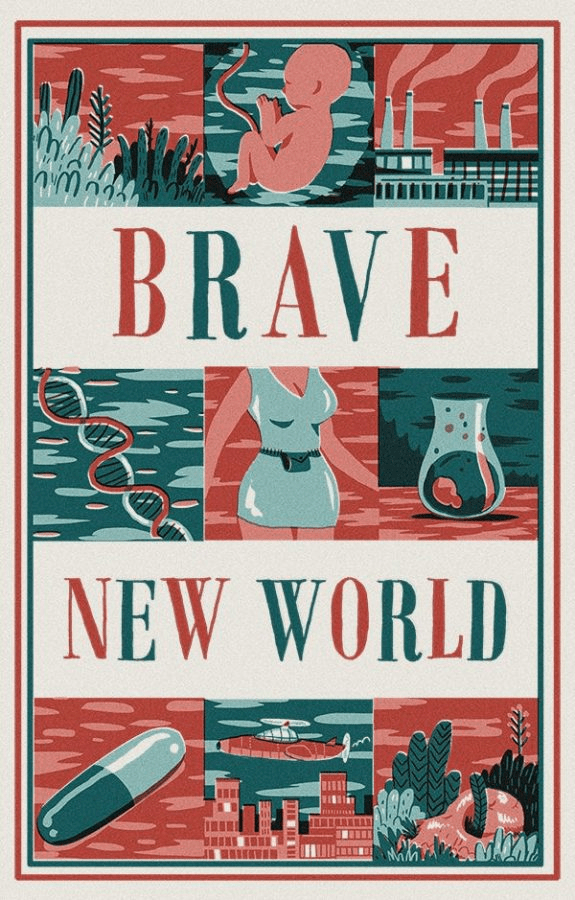
Brave New World, published in 1932, is a dystopian novel that explores the gap between the good life as prescribed by corporations and the more a nagging sense of incompleteness tells us there is. Consumerism can’t be our answer to the malaise of modernity when it itself is the germ of it.
Soma, an allusion to the botanically distilled, ritual, narcotic drink used by Indo-Aryans in the Rigveda, is the name of the numb-’em-with-pleasure, state-prescribed drug that citizens of the dystopia in Brave New World consume whenever they want a good time, or if they need to tune out of something horrible that’s just happened. It’s quite the hallucinogenic drug. It’s even used in group sessions for ecstatic, quasi-religious bonding sessions to link fellow citizens to one another and the World State.
As the World State sees it, they have the perfect recipe for personal happiness and societal stability. Everyone knows their place and does their state-sanctioned job; there’s no social conflict because of a creepy eugenics and social conditioning program that grades and places human beings on an A+ to E scale. They face no real struggle in their lives because their subsistence needs and all that they’ve been told to want are micro-managed for them by the state, and when something does unnerve them, they have soma to smooth over the wrinkles.
Paradise? Hardly, as the Candide-esque satirical tone of the narrative indicates, though this consumerist vision of paradise does make sense in its own way.
We get introduced to a character who’s from the “old world”, our world, at one point, and he’s very much upset by how superficial and hollow everyone is. He believes that because all obstacles and struggle have been cleared away by the World State for the populace, everyone has become a shell of a real human being. But here comes the sarcastic rejoinder from the head of the World State: What exactly is he complaining about? Does he want to restore diseases and suffering and visible ageing to the human condition? Is that the sort of meaning he seeks in life? Yes, an unqualified yes, is the answer of the so-called “Savage”. He wants life to have substance, and substance comes from struggle, or, more precisely, from overcoming struggle. Even if those struggles are needless? Yes, even so. Apparently, that’s the message of the novel.
Readers shouldn’t, however, be too quick to judge that this is the side on which the satire lands. Like most good satires, the novel’s incisiveness is double-edged. The Savage’s worldview seems quaint, even by our own standards, not just by the standards of a futuristic dystopia. This is someone who has read nothing besides what’s inside The Complete Works of William Shakespeare, and it doesn’t seem like he ever got to the Comedies; his is a worldview that’s dominated wholly by guilt, abnegation, violence, and passions. No wonder, then, he chooses to turn his back on all-too-cozy civilization, go live out in the wilderness, and learn to fend for himself.
There’s much satisfaction to be had in being productive and solving problems by your own lights and with your own hands, but are we really to think that the Savage is onto something? That he has a better grasp of what happiness is? He seems to me just as much a target of satire as the “brave new world” he despises and mocks when he quotes ironically from The Tempest. Pointless trouble can hardly be the secret to happiness.
So what’s there to be said about the place of suffering in the good life? Another character thinks suffering is necessary for good literature. It’s quite difficult to argue with that, since we tend to think of literature as being essentially tied up with conflict and character development. But what about the rest of the population who don’t necessarily wish to become writers? In their case, is suffering in any form just a needless nuisance? Something to be extirpated without second thoughts, like a parasite in a host organism?
There’s this to consider: intimate relationships don’t seem to be possible without empathy, and empathy flows from witnessing someone else suffer. The characters in Brave New World who are able to form intimate friendships with one another all suffer and commiserate; the same goes for deep romantic attachments—or any sort of dedication to one particular person, it seems.
What these characters suffer from is none other than their inability to fit into the rigid mold that the World State imposes on its population. They suffer because they are unable to conform and they become exceedingly self-aware in such moments of dissonance, and perhaps that tells us something about suffering: it’s an individuating experience. Not only do you suffer because you’re innately an individual, and there will always be norms that don’t sit right with you; you also suffer to become more of an individual. In Brave New World, suffering is presented as the quintessential experience that allows you to discover who you are, the nebulous stuff you’re made of.
It might even be said that suffering is essentially individuation, the pain of isolation in sensing your own grave difference from what’s normal. A pain that finds a lot of relief in knowing someone else who thinks like you or who understands where you’re coming from or what you’re going through; in this amelioration, an intimate friendship or romantic relationship takes root.
Despite the intense, ecstatic nature of those soma-induced group bonding sessions, the average citizen of the World State is hardly attached to anyone they call friend or lover. At the first sign of danger, they look out only for their own bodily safety, leaving everyone else, including those to whom they are supposedly close, to fend for themselves. This makes sense: Because they are so well incorporated into a collectivity, they fail to see themselves or others as individuals. Operating out of this perspective, and programmed to serve the greater, i.e. collective, good, they see their own survival as interchangeable with that of a friend’s or lover’s—and it’s always easier to save your own hide than go out on your way to save someone else’s. The survival of a species doesn’t require the rescue of particular individuals.
So, perhaps there is a point this satirical novel drives at in earnest, and it’s this: suffering, because it individuates, is the bedrock of intimacy.
There are echoes of what two moral philosophers with classical backgrounds, Martha Nussbaum and Bernard Williams, would say against the Kantian worldview on love, morality, and deontology. Surely, it’s moral to protect those we are partial to, over and above those to whom we’re not particularly attached? Kant doesn’t think so; in his view, we have a moral duty to everyone equally, family or stranger. Brave New World shows us a grim scenario in which the impersonal morality of Kant’s stripe can go terribly awry: if everyone is no different from anyone else, it makes sense to look out solely for yourself in times of crisis, since that might well be the most efficacious way of keeping the collective alive. As they say on airplanes, help yourself to an oxygen mask first, before attending to others. But why bother helping the person beside you if everyone is basically fungible, if there are plenty of non-individuals to spare?
In this way, suffering, by making us individuals, is what rescues us from the brute selfish indifference lurking at the heart of collectivist thinking.
Works Cited
Huxley, Aldous. Brave New World. New York City, Vintage, 2007.
 Musings of an Educator, Writer, & Lifelong Learner
Leave a comment