
There’s a wonderful story in the New Yorker, which I used to be subscribed to, and it was partially because I thought their house prose style was worthy of emulation, about how Gertrude Stein would go around the French or Swiss countryside, driven by her wife Alice B. Toklas, and Stein would have her pick of cows to look at and fuss over the perfect one to serve as a muse before she started writing. I think it would have been poetry of some sort, or shortform prose; but with Stein, it couldn’t have made much of a difference. She believed in freeform writing, which to Hemingway her protégé in some respects, just meant that she loved writing but not editing, as he observed while relating his time in Paris meeting Stein and other modernist literati like Ezra Pound and James Joyce in A Moveable Feast. What Hemingway did learn from Stein was something about the rhythm of words, the vital link between prose and prosody. It seems fair to say that Stein wrote in a way that subordinated sense to prosody, but how else can you write if what you were trying to do with your words was along the lines of capturing the unique loveliness of a singularly existent cow in the countryside before your very eyes?
Writing has both an aesthetic aspect and an abstract sense-making one for what would ideally be universal communicability. And the latter, as Mishima regards it in Sun and Steel, can be thought of as corrosive. He compares it to termites to say that writing eats away at reality; then he refines the metaphor into the acid used for etching in order to convey how writing has to corrupt reality with abstractions in order to represent it for communicability. Finally, he adds that writing should also be thought of as stomach acid, in that eventually when there is no reality out there left to corrode, writing will devour its own source, the writer, by turning the writer’s own biophysical reality of the body into an abstraction. That’s how Mishima justified why he had to start working out; his packed on muscles were armor against his own corrosive craft of writing, or so he reasoned in the years leading up to his meticulously planned ritual suicide. We must assume that his complaint about writing was fed by a general mood of despair he felt about extralinguistic existential matters.
As the reader may have realized by now, elusive cryptid that you are if you have somehow landed on this blog but know that I appreciate you spending time here with my words, I am writing this post in conscious adoption of being unformatted, freeform, loose, uninhibited, talky, meditatively and insouciantly disorganized. I haven’t updated this blog in a while because there’s been a major change in my life to do with writing that has been taking up the bulk of my time: I got into a PhD program in education and I start this fall, and I’ve been researching subfields and my interest areas in order to write articles to submit to academic journals. It’s been great learning how to write with disciplinarity in the field of education: lots of citation punctilios and things to know about how papers are organized, as well as metadiscourse. Metadiscursive locutions everywhere. The wonderful folks at Education Theory have been providing me a rigorous education in learning-by-doing with their very patient guidance through attentive feedback for an article I submitted, two major revision rounds of it. One must count oneself lucky and be grateful for such personalized help with disciplinary writing; after all, other journals rejected the manuscript after acknowledging that it was well-argued because the format of the piece was too far off from the final publishable shape it was supposed to assume.
Conventions are everything in writing, and this post is my way of letting off steam. This post is an outlet for me not to format, not to cite, not to worry about matching a disciplinary writing/knowledge community’s standards, or a readership’s expectations. It’s just to write and then to go along with one has written–I’m still editing a touch here and there but only when it’s justifiable under the banner of staying true to my authorial voice.
Bakhtin tells us our voices are re-compositions of other people’s voices, so what of our voices in writing? How do we know our real authorial voice out of the other people’s voices we’ve absorbed through reading all that they’ve written? Given that the attainment of higher education has never been so proportionately high in the world (helped by the fact that many non-Western universities only began in the 20th century), and more so if going by sheer numbers, it does feel like academic writing has left its mark everywhere, n0t just in what we read digitally but also in what we hear in reels and videos on social media.
Critique is the new lingua franca, because critique, in this era of the Information Age, often gets directed at generating engagement with content rather than overturning any system. If anything, such critique entrenches the system by offering a facsimile of resistance and revolt. And how that translates into writing is that most writers take a tone that is simultaneously critical and detached. Like as if criticism is simply a writing exercise, target practice to sharpen one’s aim but there is no real target only more target practice to perform.
We can only deduce that this type of critique is going to proliferate further now that we’re all using Gen AI as our interlocutors. They obviously don’t just analyze, but do so to keep the conversation going; they create engagement by criticizing your position while simultaneously affirming key parts of it. It’s like participating in dialectics with Socrates, but if Socrates’ purpose was not to help you find out what you actually know and what the good life is, but to make you and the way you think ultimately substitutable at a lower cost in the knowledge economy for MNC’s.
All this is by no means a portrait of academia’s effects on us. It’s rather a portrait of a consumer culture that has parroted the symbolic resources and institutional aims of academia. But of course, consumers really ever only want more things to consume, and influencers know how to oblige, and in this digital marketplace of viewpoints the language of critique gets co-opted and transformed into additional streams of commerce.
In this digital age of writing, then, a new kind of honesty is needed, both for authenticity and revolt. One ought to write about cows: the pet subjects of one’s idiosyncratic interests. Forget about traffic, engagement, communicability and all that stuff. Relevance and relatability are not pre-requisites for writing, and should never be. To find one’s authorial voice, one has to leave the metaphorical herd and find a literal herd of cows and just sit there in the plains and observe–and care. The alienating thing about commercially ritualized critique is that one does not need to truly care about the issue at hand; but the conventions of critique position the writer as one who clearly does; and so when such a writer wishes to write for practice, they are also at the same time made to feign to care under the influence of the genre, or at least they’re feigning more care than what their writing exercise evokes.
This can’t be good for cultivating an authentic writing style because ultimately how one writes is an outgrowth of the relation between the writer and his subject matter. If you do not actually know what subject matter resonates with you so sonorously as to draw out your voice, in speech or writing, then you will not find a style to call your own. Style is expression, and expression depends on the desire to express not just for the sake of expression but for what one cares about. But I believe we can all easily unlearn in our writing what can be called, after Bruno Latour, critique without steam, and learn to care instead.
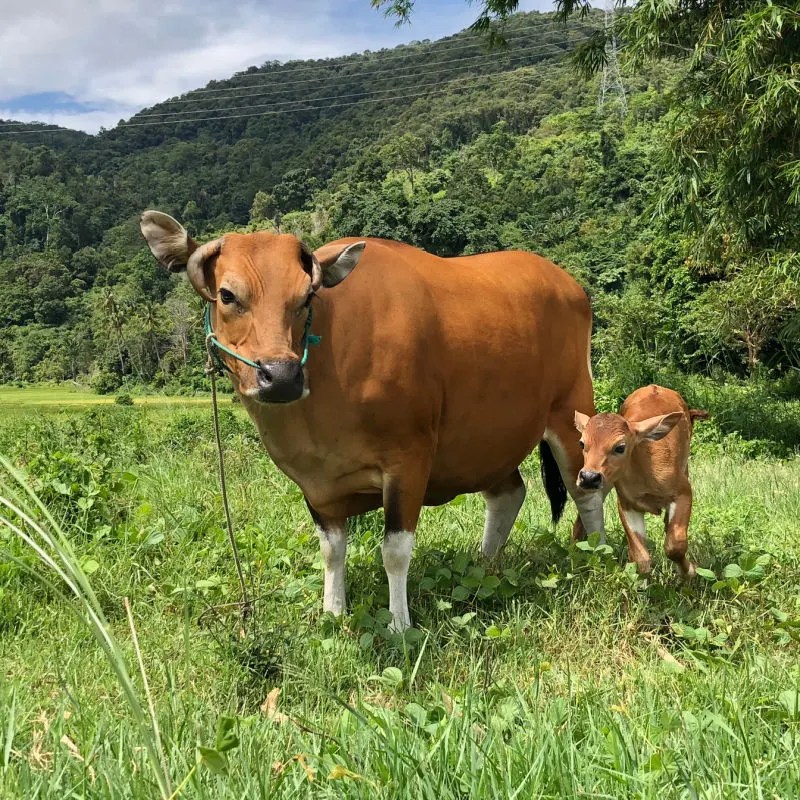
Like Gertrude Stein, who if she knew nothing about editing nonetheless knew everything about writing authentically, one has to write with a cow in view. The classical epic poets had their muses, but if you can’t work yourself up to being possessed by a god, you can always find a cow in an animal shelter near you. Here’s two to start you off.


Leave a Reply